Monday, November 23, 2009

Southern Florida:NASCAR

One of our objectives in this part of Florida was to attend the season's final NASCAR race in Homestead, Florida.
Of course, we had to have photos of several key drivers. This is Dale Earnhart, Junior, Tyler's favorite.
This is Vancouver, Washington native, Greg Biffle.
Here is Brent's favorite driver, Tony Stewart.
The festivities started long before the race. The RV park where we stayed had live bands every night. One evening, this balloon showed up and gave free rides to anyone who wanted one. They were right out our windshield.
One of the things that first impressed us was all of the fan gear we saw in the park and at the raceway. Of course, many sports fans are not only race fans. We thought this bike was really well done.

Not only did it have Yankee pinstripes, but this very nice depiction of Yankee Stadium. It was a true work of art. What do suppose this cost?
Of course, there were lots of caps around, but we thought this one was the best. Note the rear spoiler on the back of it, similar to the ones you see on the race cars. This guy must have been a lot faster than he looked.

The number of profit centers here was astounding. Of course, you would expect race gear, every driver had one of these. There were also lots of food and drink courts, and much gear that had little to do with NASCAR for sale. There were also Army and National Guard recruitment centers.

Here's another profit center. These scanners pick up the race broadcast. You can buy one for $150.00, or rent one for the weekend for $49.00! One of these or something similar by Radio Shack was the only way that fans at the track could hear the announcer.

The next thing you notice is that cameras are everywhere. Here's one on top of the building, and another coming around behind it in the form of the Goodyear Blimp.

Tthe ceremonies started. This flag was towed around the track.

The stage was towed into place and introductions were made.

There was the prayer, National Anthem, and flyover.

Because of where we were, we got a bonus from the flyover. Homestead Air Force Base was behind our seats, so the jets had to fly over once more as they landed. This one just happened to come in as the blimp passed in the background. You remember Homestead Air Force Base, it was where a defecting Cuban pilot landed a Mig 17 only a few hundred feet from Air Force One in 1968.

From our seats, we could see the entire racetrack, but if we didn't have good view of the action from where we were seated, this big screen TV showed what we missed. We did, however, miss some of the TV narrative, so Pen kept up a constant text message flow with Brent who was watching the race at home in Vancouver.
Just before the race started, we saw this sad exodus. This was one of the drivers who failed to qualify, so he loaded up the truck and headed home.

Finally, the race started. This is the first lap of the Nationwide Race. It is the junior circuit, although several of the senior circuit drivers usually participate. Overall, we thought it was the better race.
Although he didn't finish in first, in the senior circuit race, the night belonged to this guy, Jimmy Johnson. He earned enough points in this race to cinch the season championship.

We enjoyed our weekend, and saw a lot of interesting things. One more thing to check off our bucket list.

Friday, November 20, 2009

Titusville and the Kennedy Space Center

From Jacksonville, we went south to Titusville. We stayed The Great Outdoors RV Resort. It is beautiful and very upscale. It is so large that it has its own wildlife preserve, church, post office, RV dealership and repair, three restaurants, beauty shop, manicurist, acupuncturist town hall. . . .

Many of the sites, such as this one next to ours (sorry, I forgot to take a photo of the one we stayed in) are covered by porticos. There are also several very upscale houses with RV ports attached. By upscale, I mean selling for a half a million and more and they look worth it. Many of the residents get around the resort in golf carts. Have a fantasy about owning some car or another? You can have one of these at a fraction of the cost, but a lot more than most of us would pay for a golf cart.
Not far from here is Port Canaveral. These two cruise liners were docked. Double click the image and you can see Mickey Mouse on the one to the left. Obviously it is a Disney cruise ship.
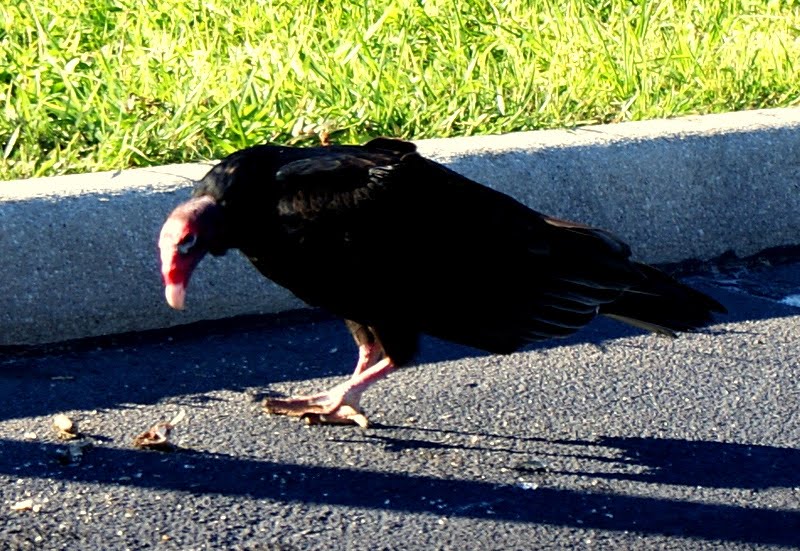
Just beyond it, this turkey vulture was more than happy to help some fishermen dispose of unused bait. Interestingly, we saw very few seagulls here. I suppose these guys keep them shooed away.
Turkey vultures and black headed vultures such as this one seem to have their own, rather well defined territories.
There is a lot of wildlife hereabouts. These two wild pigs were playing beside the road at the Kennedy Space Center. The black one literally ran rings around the red one. We were told that employees at the space center must check underneath their cars for alligators if they leave late at night.
One of the first things you see as you approach the Kennedy Space Center is this rocket garden. Each of these vehicles played an important part in our space history. In the left foreground is a Redstone configured similarly to the one that boosted our first spaceman, Alan Shephard, into his suborbital flight.
This is the space suit he wore on that flight. It is in the Astronaut Hall of Fame less than a mile from the Kennedy Space Center.
This is the Vehicle Assembly Building used for the Saturn V and the Space Shuttle. It can be seen from miles around. The superlative that most impressed me was that you could fit Yankee Stadium on top and still have an acre to spare. To the right rear is a pad being constructed for the Ares, the next generation space vehicle that will replace the shuttle.
This building houses an unused Saturn V. It's hard to imagine that this thing even moves, let alone flies into space.
This is the walkway over which the Apollo astronauts took their last steps on earth before splashing down after completing their missions. I must say, I had to catch my breath as I walked across it.
This is a view inside the lunar lander. Hard to imagine spending a couple of days in here, particularly the way that the astronauts of Apollo 13 had to do.
This is the crib sheet that the real moonwalkers wore on their sleeves. It detailed the proper way to sample moon rocks. To the right is the flashlight they used to read it.
Nearly thirty years ago, I promised Penny I'd fly her to the moon. Here she is feeling a small piece of moon rock. Does that count?
We really came to see the shuttle. This is the crawler that moves the shuttle from the assembly building to the pad. It can position it's load to within an eighth of an inch in any direction.
This engine, mounted in the observation tower was retired from the shuttle after leaving the earth three times. In case you're wondering about all the coats and jackets you see, it was a really chilly day, not midwest chilly, but cool nevertheless.
Here she is sitting on the pad.
Shortly before launch, they move the large gray structure that obstructs your view of the shuttle in the photo above away, and this is what you would see.
Here is a mockup of one of the labs that rode the shuttle into orbit. It was interesting to walk through them.
This is the clean room where future shuttle loads are being prepared.
There she goes!!! We barely saw her before she was in these clouds. Not too impressive until you realize that they won't launch unless the clouds are no lower than 5,000 feet.
Almost as quickly as she entered the clouds, she broke out over the top of them.
Double click this image, and you can see the two solid rocket boosters falling away as the shuttle continues on her own engine.
In the background is the smoke created by the shuttle. This bald eagle watched the whole thing undisturbed. It was almost as if he was reminding us that he and his kind were soaring high above the earth for millions of years before we got the hang of it. Penny's take was that his presence added a reminder of our need for national unity in this endeavor.

Monday, November 16, 2009

Mary Ball Washington Museum and Library, Lancaster, Virginia

A big advantage of living in our RV is that I (Penny) can research my family history in the locations where my ancestors lived. To be able to look at a marriage record, will, deed, etc. that was recorded near the time of the event often reveals data that cannot be found any other way. Often I find something that changes the information I have. This is usually because the person who read the document did it inaccurately, i. e., Bety is really Betsy.
This building is one of only a few in Lancaster, Virginia. At least three branches of my mother's family once lived in Lancaster County. The courthouse is on one side of this building and a tiny genealogy library is on the other side. I have been visiting lots of courthouses and local libraries. The Mary Ball Washington Library is quite amazing, especially for its size. I spent three days there and found more than I had time to copy or record. Oh, darn, guess I will have to go back.
The group that runs the library also maintains a museum. This is the ancient jail that is part of that complex.
Craig Kilby is a professional genealogist who volunteers at the Mary Ball Washington Library. I got terrific help the other two days I spent there, but Craig's knowledge and enthusiasm was far above average. I learned more in that one day about sources, research, and websites than I have in the 30 years I have been interested in my family history.

Thursday, November 12, 2009

Jacksonville & St. Augustine

From Brunswick, we went to Jacksonville, Florida. Jacksonville is in Duval County. The county was named after William Pope Duval, the first Governor of Florida Territory, and Penny's second cousin five times removed. If for no other reason, we were glad to see the area for which one of her family members was the namesake.
We arrived in Jacksonville in time for the big University of Florida/University of Georgia football game. Shortly after we arrived, the fans started pouring in. These three coaches were Gator fans.
The Georgia fans were not to be outdone. Between a couple of these coaches was a pavilion tent with what looked like a pretty good party going.
We waited until the game was over to see downtown Jacksonville. In this photo, a water taxi is passing a signature fountain. There is no old town Jacksonville to speak of. A fire in 1901 wiped out much of the city. 10,000 buildings were erected between 1901 and 1912. Most of those have since been razed and replaced by newer construction. Jacksonville was once considered the winter motion picture capital, but the conservative nature of the local politics along with the emergence of Hollywood put an end to that.
Andrew Jackson was the namesake of the city. He was highly esteemed in the area because he chased the warring Seminoles out of Eastern Florida.
We found these whimsical signs, placed around the downtown area quite delightful.
As you might expect, it takes a lot of power to keep all of those air conditioners running. In this complex are generators powered by coal, oil, natural gas, and biomass.
In the edge of Jacksonville is the Timucuan preserve, named after the local tribe of Native Americans. American beautyberries, such as these, were once a folk remedy used to repel biting insects. They are plentiful in this party of the country. The trees in the background ranged from two species of liveoaks, to at least three species of hickories, to longleaf pines, to baldcypress in wet areas, and were heavily festooned with Spanish Moss.
This reproduction of a Timucuan hut sits next to a pile of oyster shells, indicating a staple of their diet.
This column is a reproduction of the column erected by the French Huguenot explorer Jean Ribault somewhere near this area.
There weren't a whole lot of people at this monument, but we had plenty of company. These little guys were everywhere.
Two years after the Ribault expedition, Rene Gaulaine de Laudonniere, seeing an opportunity for the French Huguenots to have a place of refuge where they could prosper, established Ft. Caroline, reproduced here. It was the first European settlement in the new world. Unfortunately, the following year, a Spanish force from nearby St. Augustine overran the fort, and killed virtually everyone here. It's unclear whether this was a reflection of the Spanish Inquisition of nearly 100 years earlier, or simply a pragmatic desire to not have to share this land with any other country.
This is the only entrance to the Castillo de San Marcos. Construction was initiated in 1568 after a pirate raid left the surrounding town of St. Augustine devastated. The moat over which these bridges are constructed is and was designed to be dry. During hostile action, the Spanish drove their cattle here to keep them from being stolen and give them some semblance of safety.
About the only type of rock available to build this fort was a local stone known as coquina. It is the compressed calcareous remains of millions of generations of small shelled organisms. In a few million years, this would have turned into limestone, but as it was, it was excellent for construction of a fort. When cannonballs struck this stone, rather than fracturing, a few inches of shells simply compressed into the numerous air spaces, and the projectile fell harmlessly
to the ground. This model illustrates the ingenious configuration of the fort. Cannons of the day could only be swiveled a few degrees. Despite this, overlapping fields of fire could cover any direction from the fort. It was never taken by hostile action.
Some of the cannons facing the Matanzas river line up in one of the corner bastions. During Spanish occupation, no soldiers lived within the fort. Rather, they lived in the surrounding community and came to work their twenty four to forty eight hour shift in the fort at the appropriate time.
This a the view looking down from one of the corner bastions. The oven was placed outside the main walls of the fort. Having something like this anywhere near the powder magazine was not a particularly good idea.
Here, in old St. Augustine is an oyster shell tabby wall similar to that shown in an earlier blog entry from Savannah. We've seen quite a bit of this stuff in several places. What a great way to use locally available materials.
Another building in St. Augustine is shown here. Built over 200 years ago, it is billed as the oldest wooden schoolhouse in North America. Of course, Penny had to have a photo of it.
This is old town St. Augustine. During early English colonization, St. Augustine accepted runaway slaves as a part of the community. It later became a part of the underground railroad. Obviously, it has now become quite a tourist attraction. There are a number of neat little shops and great smelling restaurants down this street. I'll have to admit, we did leave a bit of money there.
Dating from some time before 1750, this house was once owned by an early Spanish Treasurer. Later, it was a home for Governor John Moultrie, brother of William Moultrie, namesake of Ft. Moultrie, SC, and a revolutionary war hero. The house finally become the property of a local physician who willed it to the city.
This is Ponce de Leon Hall of Flagler College. Built adjacent to old town St. Augustine, it was once the Ponce de Leon Hotel. One of the driving forces and large benefactors behind the hotel's conversion to an institution of higher education was Lawrence Lewis Jr, Grandson of Henry Flagler. Flagler was a partner in, and provided $100,000 dollars seed money for John D. Rockefeller's business venture which later became Standard Oil. Flagler is highly regarded in much of Florida since he also provided money for many Florida development projects.