Tuesday, March 25, 2014

25 Mar 2014, Our first day in Santa Fe, NM

 
Most of us will likely recognize the flag New Mexico.  What I didn't know until today was the meaning of the Zia Sun Symbol it features.  To the Zia, four was a sacred number.  The symbol represents the four directions, the four times of day, the four stages of life, and the four seasons.  All are bound together by the circle of life.  For many years, children in New Mexico schools recited the morning salutation: "I salute the flag of the State of New Mexico and the Zia symbol of perfect friendship among united cultures."  Beautiful.  
 The architecture of the Santa Fe flows in very pleasing lines.
The St. Francis Cathedral accents the foot of West San Francisco Street.
The New Mexico Museum of Art, seen here, is a work of art in itself.
The monument at the Center of the Plaza was built in 1866 and dedicated to, "The Heroes of the Federal Army who Fell at the Battle of Valverde", the first of the Civil War Battles fought on New Mexico soil.  Plaques on the other three sides commemorate other battles between the states and with Native Americans.  
Here, on the walk outside the Palace of the Governors, Native Americans exhibit their beautiful craftwork.
Even the park benches are fascinating.
These are the work of Bill Worrell.  They are based on cave paintings that he encountered by accident.  This one has stood outside his gallery in the background for twenty-five years.
These knives and the corkscrew were featured at a shop just off the plaza.  Ted admired a set of steak knives, but quickly realized that at $500 for a set of four, he would never allow anyone to actually cut a steak with them.
From the plaza, we went to Canyon Road.  It is a very narrow, one way for most of its length, road that is lined with gallery after gallery.
 
One thing that became apparent very quickly was that the week that we had planned to spend here would be insufficient.  It seems likely that we will return.

Monday, March 24, 2014

24 Mar 2014 Acoma, NM to Santa Fe, NM

 Gorgeous drive across I-40 today.  Since we have photos of this drive on previous blogs, we just enjoyed the ride.  Love this overpass art in Albuquerque, NM.  
 There were NASCAR races this past weekend in Fontana, CA.  Next weekend they race in Martinsville, Virginia; a long haul in a short time.
 At Albuquerque, we turned north onto I-25.  Why can't all cities paint their suspended highways?  I know; money, but I can still wish.
 Roadside art, Albuquerque style.
This is the view out our windshield at Santa Fe Skies RV Resort, NM.  We will be here for a week while we explore Santa Fe; a bucket list destination for Penny.
 We are trying to remember to take photos of the parks where we stay so that, those of you who RV, can have some idea of what the parks are like.

Sunday, March 23, 2014

23 Mar 2014 Meteor Crater, AZ to Sky View, NM

 After almost freezing temps during the night, we woke to a beautiful day in Meteor Crater RV Park, NM.
 The park is not luxurious, but it had all we needed and was perfect for a short stay.  Next to us were two couples on their way to Alaska for the fourth year in a row.
 I-40 runs beside or on top of the former Rte 66.  This is a modern version of the many tourist traps that once existed along 66. 
 Not far into New Mexico is a nice rest stop with a visitor center at this cave.
 These land features are near Gallup, NM.  If this looks familiar, but you've never been here, there's a reason for that.  This area was was the site of many movies in the 40s and 50s.
 At 3 pm, Mountain Time, we stopped at Sky View RV Park at Exit 102.  There is a casino and travel center where we will get fuel in the morning.  Like the last stop, it works for an overnight.
This is the view out our windshield.  We will take the shuttle to the casino for dinner.

Saturday, March 22, 2014

22 Mar 2014 Barringer Meteor Crater, AZ

One of the places on our bucket list was the Barringer Meteor Crater. 
  It is definitely in the middle of nowhere as this photo, taken from the front steps to the entrance, indicates.
Despite the geological and astrological significance of this area, it is not federally owned.  It is, however, designated as a Federal Landmark.  The entrance fee is $15/person, but we had discount coupons from our RV park, which is six miles form the crater.  There is a movie about the history and science of the crater, a museum, several walk ways with free telescopes focused on features, and a guided tour.
 Borrowed from http://www.edupic.com, here is an aerial view of the crater.  The square appearance is believed to be the result of pre-existing cracks in the strata.  It lies at 5740 feet in elevation, and is 3900 feet wide and 570 feet deep.  It was approximately 200 feet deeper, but has been filled in by erosion.  It is the best preserved crater on earth. 
 In 1903, Daniel Barringer, a mining engineer, suggested, contrary to the popular theory that it was a volcanic caldera, that it was produced by the impact of a meteorite.  Skeptics continued to reject Barringer's hypothesis until it was confirmed by Eugene Shoemaker, husband of Carolyn Shoemaker of Shoemaker-Levy fame. 
Most of the meteorite evaporated upon impact, but the Holsinger meteorite, at 1409 lbs., is the largest fragment of the meteorite.  There are several other known fragments.  Some are as far away as Christchurch, New Zealand and Paris. 
 Barringer filed for and was granted a mining grant.  This is a boiler and one of the shafts that was sunk in search of the remainder of the meteorite.  The Barringer family still controls the area.  Despite the early mning efforts, they have been good stewards.
 This six foot tall astronaut and American flag commemorate the use of the crater as a training site for Apollo astronauts.
 Looking like a tree growing from the back of a stone alligator, this juniper captured our attention as we drove along the access road to the crater.
Instead, it is a more subtle demonstration of the power of nature.
These rocks provided excellent shelter for small animals.  Note that something has dug out and pushed soil along the edged of this rock. 


21 Mar 2014 Phoenix, AZ to Meteor Crater, AZ

 Heading north on I-17, we saw art at each interchange.  Beautiful, fit the culture, and low maintenance.
 The gila monster is my favorite.  There was a twin on the south bound side.
 Love it.
 There was an electronic sign warning us of this semi roll-over.  Hope that the driver was okay.  We barely slowed down.
 Ted never tires of the saguaros.
 Quite a way north of Phoenix, we came to this lone interstate art. It continued in the underpass.
 There are rest stops along the way.  We even have a book that tells us where they are, but sometimes their location and the needs of the driver do not match.  One of the benefits of traveling like this is that your rest stop can be any place that you can pull off the road.  Thankfully, many off ramps have wide shoulders.  
 Humphreys Peak was our beacon as we neared Flagstaff.  All our previous trips to the area have been in the summer, so this was the first time we saw it with a snow cap.
 After turning right onto I-40 at Flagstaff, we saw nothing but this ahead of us.
Exit 233 leads to Meteor Crater six miles south.  Near the freeway is Meteor RV Park. Registration is in the Mobile station store.  Through the gate is a clean gravel park with full hook-ups.  

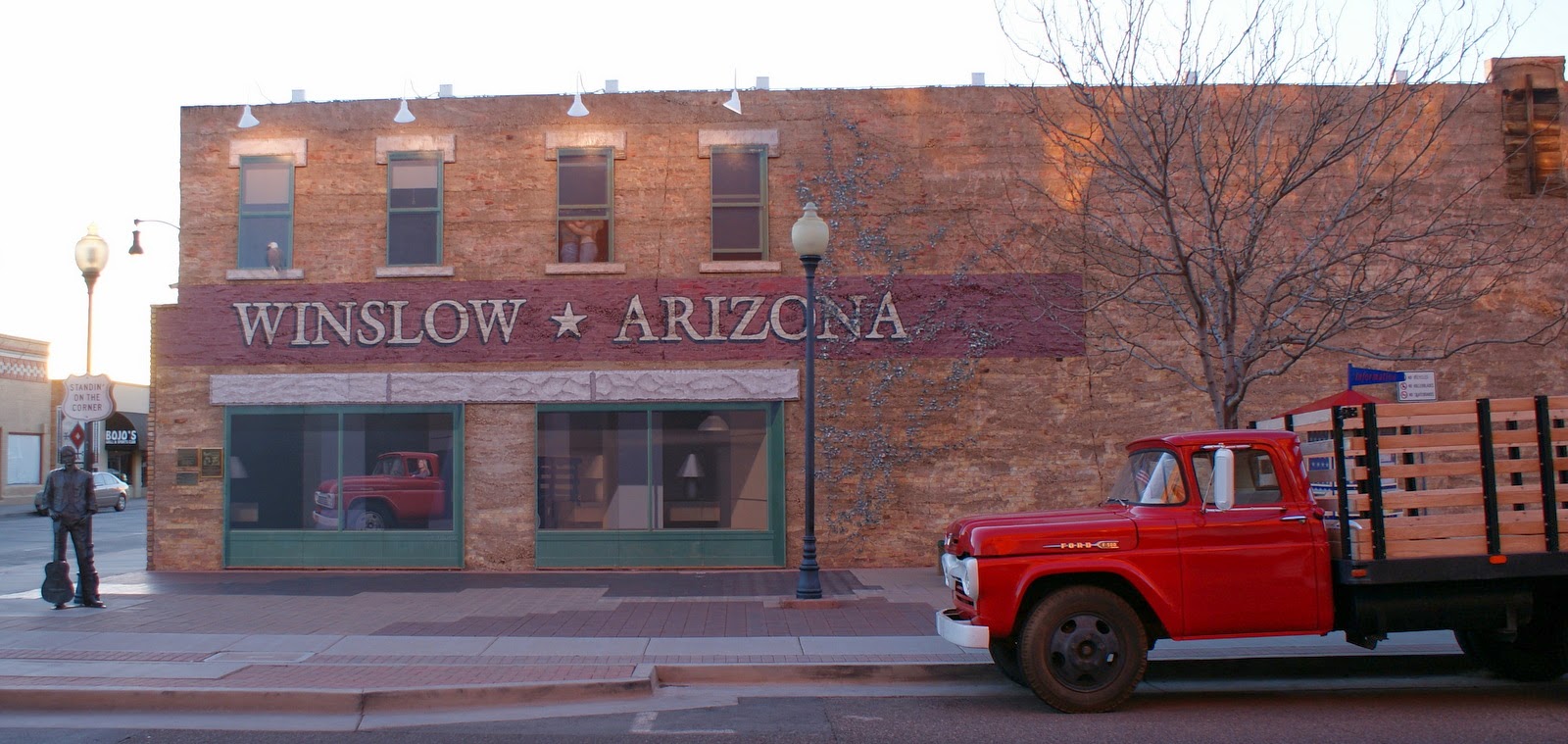
 If Winslow, AZ sounds familiar, it should.  Jackson Browne wrote the song "Take It Easy" and the Eagles made it famous.  The song contains the lyrics: Well, I'm a standing on a corner 
in Winslow, Arizona and such a fine sight to see. It's a girl, my Lord, in a flatbed Ford slowin' down to take a look at me.  Note the eagle and the kissing couple in the upper floor windows.
 A statue of Jackson Brown and a real flatbed Ford complete the corner in Winslow, AZ.
 This is the gate to a restored treasure.  La Posada was the last of the Fred Harvey hotels, built by the Santa Fe Railroad in 1930.  Harvey Girls were famous for the excellent service provided to restaurant customers.  Judy Garland starred in a movie about them. 
 Howard Hughes, John, Wayne, Bob Hope, Dorothy Lamour, Albert Einstein, and the Crown Prince of Japan have walked through these doors when Winslow was bigger than Flagstaff and Sedona.  The interstate meant fewer people rode trains or drove down Rte 66 into the town. The hotel closed in 1957 and was made into railroad offices.  It was bought in 1997 to prevent it being torn down.  Now it is restored and thriving.
This display of kachina dolls are on display in the lobby.  Steve, this photo is for you.
 The burros overlook the entrance.  We had thought that we would eat in the Turquoise Room in the hotel.  After looking a the menu, we decided that $35/entree was more than we wanted to spend, so we went across to the street to the Brown Mug Cafe, which sported a 5 star rating by Google.
 The food was delicious, service great, and local color amazing.  We had to be the only tourists.  Everyone knew each other.  The cost was $17 for both of us.
It is a good day when we find so many unexpected places and experiences.  That is the fun of this life.